
الأنظمة الصحية
توصيات DDI/DGI/DCI قابلة للتنفيذ داخل سير العمل السريري.
توصيات DDI/DGI/DCI قابلة للتنفيذ داخل سير العمل السريري.
تمكين المختبرات بإشارات DGI ضمن طبقة قرار موحدة قابلة للتشغيل.
تسريع برامج الدراسات والترجمة السريرية عبر إشارات دوائية موحّدة.
قرارات تغطية مدفوعة بالأدلة الواقعية وقياس الأثر.
تثقيف مبسط لدعم التزام المرضى ومحادثات العلاج الأكثر أمانًا.

PGxAI and Novo Genomics are collaborating to enhance AI-enabled pharmacogenomics in Saudi Arabia, aiming to improve personalized prescribing and medication safety. Their initiative includes local lab processing, AI-assisted analysis, and clinician-ready reporting, which will reduce turnaround times and expand access to precision medicine. The partnership aligns with Saudi Arabia's Vision 2030, focusing on training, technology transfer, and research to position the Kingdom as a leader in AI-driven precision medicine. The program emphasizes voluntary patient participation and aims to reduce adverse drug reactions while ensuring equitable access to healthcare.

PGxAI and Mahd Sports Academy are partnering to bring advanced genetics and AI into athlete development across Saudi Arabia, with the goal of improving personalized training, preventing avoidable injuries, and enhancing overall performance. The collaboration will integrate genetic, phenotypic, and biometric data into secure, coach- and clinician-ready workflows while ensuring all data is stored and retained within the Kingdom under Saudi Arabia’s Personal Data Protection Law. The initiative emphasizes voluntary participation, clear communication of insights, and equitable access for both men’s and women’s sports, while supporting Saudi Vision 2030 through training, technology transfer, and research to strengthen national expertise in sports science and precision performance.

PGxAI has announced a strategic partnership with Lean Business Services and Najashi Holding to deploy AI-driven pharmacogenomics across Saudi Arabia in support of the Kingdom’s Vision 2030 Health Sector Transformation Program. The initiative aims to establish a fully in-country precision medicine ecosystem, ensuring that genomic data is analyzed, governed, and retained within Saudi borders to strengthen data sovereignty and national security. By integrating AI-powered pharmacogenomic insights directly into clinical workflows and electronic health records, the partnership seeks to reduce preventable adverse drug reactions at population scale and shift Saudi healthcare from reactive treatment to predictive, personalized prescribing.

PGxAI has been selected as a finalist in the HLTH USA 2025 Startup Pitch Tournament, highlighting the company’s expanding impact in AI-driven precision medicine.

PGxAI has partnered with Riyadh-based Najashi Holding to bring its AI-powered pharmacogenomics platform to Saudi Arabia.

PGxAI appoints Roni Zeiger-former Meta Head of Health Strategy, former Google Chief Health Strategist, and co-founder of Smart Patients-as Product Strategy Advisor to strengthen patient-centered product development and AI strategy in pharmacogenomics.

PGxAI has been admitted to the Creative Destruction Lab (CDL) Seattle 2025-2026 program in the Computational Health stream at the University of Washington’s Foster School of Business.

PGxAI appoints John Quackenbush-Harvard biostatistics chair, White House Open Science honoree, and Genospace co-founder-as Scientific Advisor to strengthen multi-omics analytics, reproducibility, and nationwide interoperability.

PGxAI and Sequencing.com formed a strategic partnership to introduce PGx reports on Sequencing.com and advance affordable, safer prescribing through pharmacogenomics.
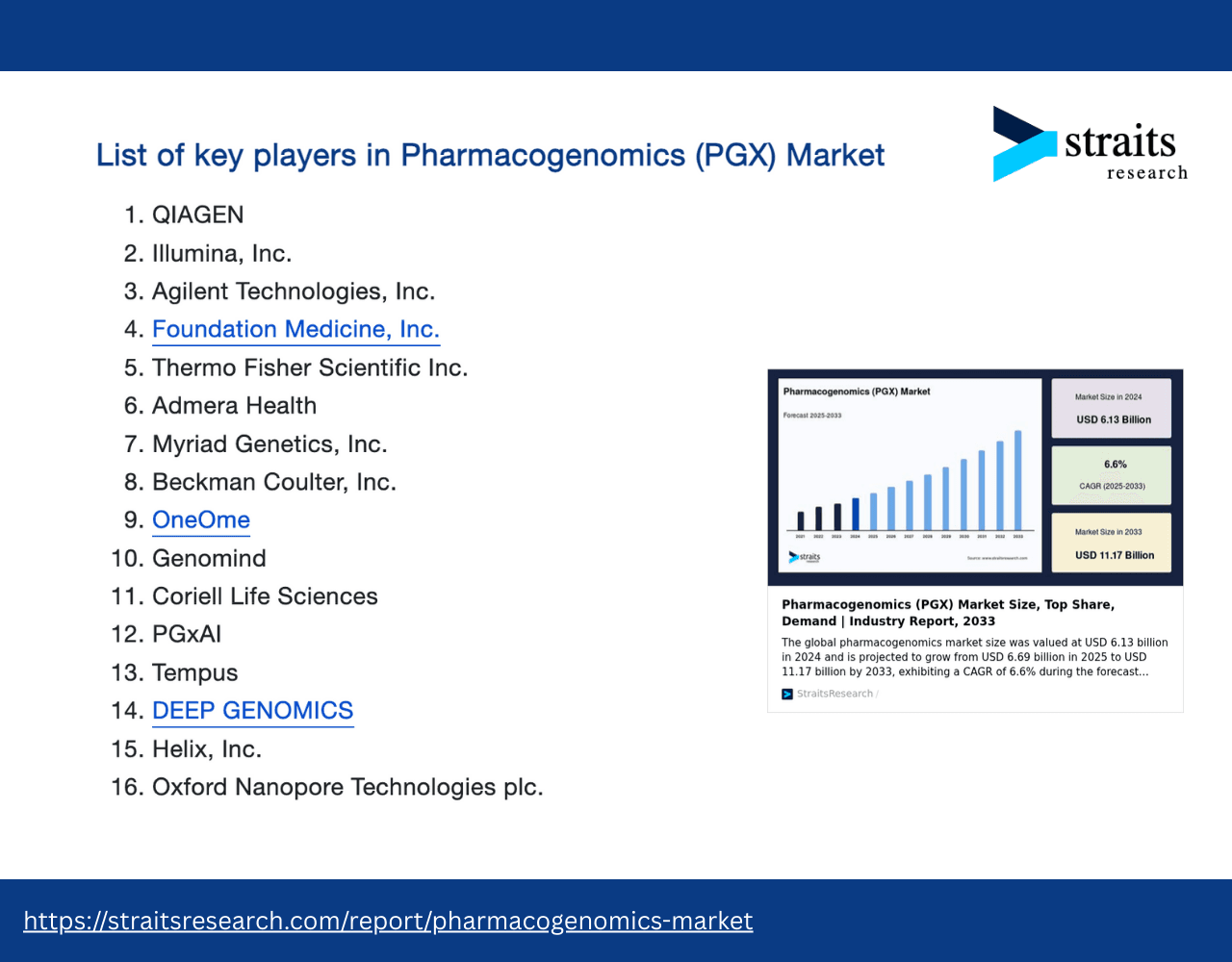
Straits Research included PGxAI among key players in its Pharmacogenomics (PGX) Market report (2025-2033) and profiled the company as an emerging innovator. The report projects market growth from $6.13B (2024) to $11.17B (2033) at a 6.6% CAGR.

PGxAI appoints David Blumenthal, former National Coordinator for Health Information Technology, as Scientific Advisor to guide digital-health strategy and integrate precision-medicine innovations with nationwide health IT infrastructure.
- Evaluated 5 leading LLMs on 599 CPIC-aligned gene-drug-phenotype scenarios to reproduce guideline-based PGx recommendations. - Introduced a validated semantic evaluation metric (LLM Score) alongside standard lexical metrics. - A domain-adapted model reached LLM Score 0.92 with significantly faster inference than general-purpose models.
An open-access review in Mayo Clinic Proceedings: Digital Health shows how AI-enabled integration of genomic, transcriptomic, proteomic and metabolomic data is reframing pharmacogenomics. The paper distills recent breakthroughs, real-world evidence and remaining hurdles on the path to routine precision prescribing.
PGxAI has introduced Betelgeuse, a real-time AI model that analyzes clinical outcomes and adapts treatment recommendations on the fly. Built to complement the previously launched Deneb, Betelgeuse integrates multi-omics and real-world patient data to help healthcare and research teams optimize therapies and reduce adverse event risk by ~30%. The model marks a key advancement in PGxAI’s precision-medicine platform-shifting from prediction to dynamic therapeutic adjustment.

PGxAI now offers free direct upload of custom genomic files in every base model, delivering instant, compound-specific drug-sensitivity readouts. Paid API endpoints remain available for high-volume, workflow integration.

PGxAI introduces an FDA-label-derived DDI module, offering real-time interaction checks in both open CLI models and enterprise API workflows.

PGxAI has released an AI-driven genetic report that tailors GLP-1 therapies-including semaglutide brands Ozempic® and Wegovy®-to each patient’s genome, flagging high-risk variants and delivering actionable dosing or alternative-drug guidance within minutes via EHR integration.

PGxAI has launched Deneb, an AI pharmacogenetics model for biopharma and CROs that fuses molecular, physicochemical, and genomic data to deliver real-time PGx guidance, cutting trial costs and speeding drugs to market.

PGxAI has embedded automated phenoconversion in all base models, instantly recalibrating genotype-based predictions to reflect co-medications and clinical modifiers; the feature is live in the web portal and available via enterprise REST API.

PGxAI has unveiled Vega, an AI-powered pharmacogenetics model that instantly converts a patient’s genomic data into drug-specific treatment recommendations, covering 1,200 drugs and 350 genes-vastly surpassing traditional panels.

PGxAI has raised $1.5 million to scale its AI-powered pharmacogenetics platform, funding upgrades to its VectorSearch and GenAI tools and deepening its partnership with InterSystems to deliver ultra-precise, genome-guided prescribing.
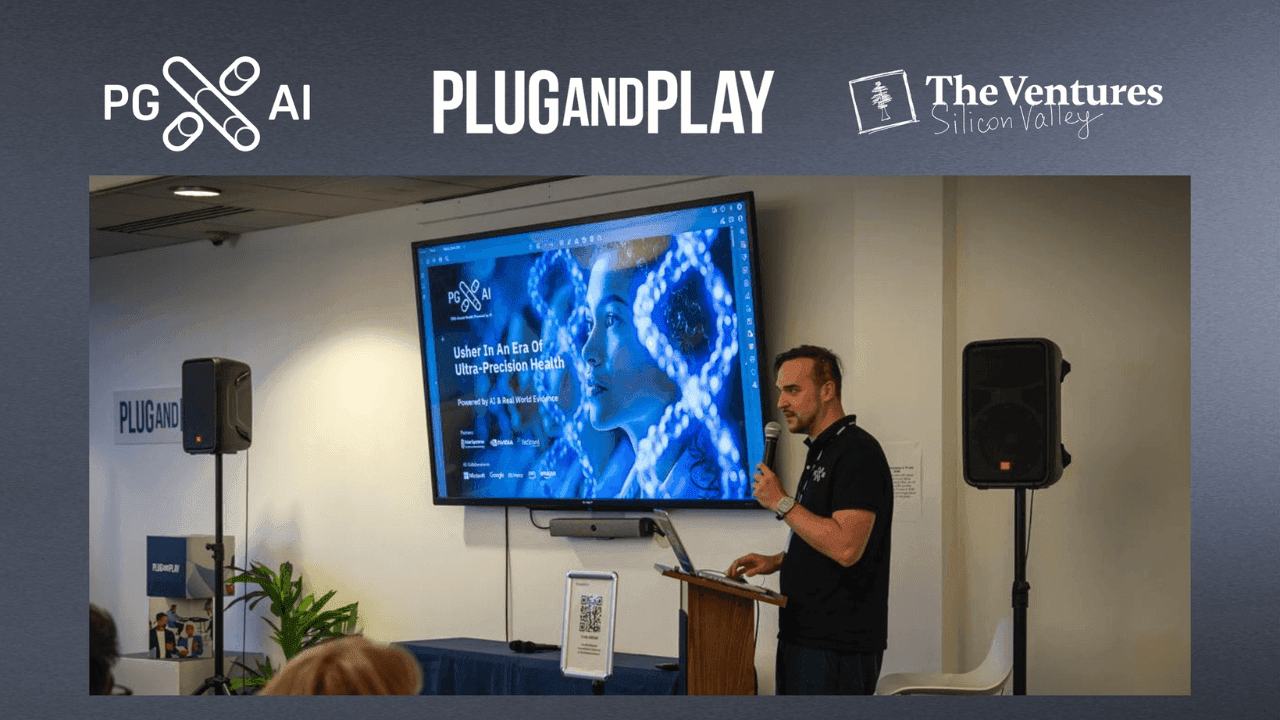
PGxAI captured the top prize at The Ventures Award-Silicon Valley’s roaming startup showcase-outshining hundreds of global contenders with its AI-powered pharmacogenomics platform. The tour now heads to Chicago on 7 Feb 2025 before expanding to other tech hubs worldwide.

PGxAI has launched Sirius, an AI-driven pharmacogenetics model that tailors drug choice, dosage, and interaction management to each patient’s genome, enabling ultra-precision prescribing for hospitals, labs, and CROs.

BioStrand (ImmunoPrecise) and PGxAI are partnering to build an AI-driven pharmacogenomics model on BioStrand’s LENSai platform to deliver personalized drug-response predictions and speed up LENSai API adoption.


